
Using Iconclass
The
unique elements of the Iconclass system are its alphanumeric classification
codes, called notations. Notations always begin with one of the digits 0 – 9,
corresponding with the ten main divisions of Iconclass.
Notations can be used to describe or index
the subjects of visual documents regardless of the complexity of the subjects.
Several notations can be used to describe complex subjects.
Every notation is part of a hierarchical structure and as such incorporates
all of its iconographical broader terms. The text explaining the meaning of an
Iconclass notation is the notation’s ’textual correlate’.
Main divisions of the Iconclass classification
system
The main divisions of the Iconclass system are represented by digits 0 to 9.
Of these ten ‘main divisions’, the numbers 1 to 5 are ‘general’ topics, designed
to comprise all the principal aspects of what can be represented. Divisions 6
through 9 accommodate ‘special’ topics, coherent subject matter of a narrative
nature, with an emphasis on the Bible (7) and Classical Mythology (9).
A tenth division, represented by the number 0, was added in 1996
at the request of Iconclass users, to accommodate abstract art.
| 0 | Abstract, Non-representational Art |
| 1 | Religion and Magic |
| 2 | Nature |
| 3 | Human being, Man in general |
| 4 | Society, Civilization, Culture |
| 5 | Abstract Ideas and Concepts |
| 6 | History |
| 7 | Bible |
| 8 | Literature |
| 9 | Classical Mythology and Ancient History |
Subdivisions:
Increasing specificity
Within each division of Iconclass, definitions are organized according to a
logic of increasing specificity. A main division is divided further into a
maximum of 9 subdivisions by adding a second digit to the right of the first
one. Division 2 Nature, for example, is subdivided in the following way:
| 21 | the four elements, and ether, the fifth element |
| 22 | natural phenomena |
| 23 | time |
| 24 | the heavens (celestial bodies) |
| 25 | earth, world as celestial body |
| 26 | meteorological phenomena |
| 29 | surrealia, surrealistic representations |
The third level of specificity is attained by adding a letter in upper case.
For reasons of legibility in the original printed version of Iconclass, the
letter ‘J’ was omitted. Thus the addition of a letter permits as many as 25
subdivisions instead of 9, and it also increases the legibility of the
notations.*)
| 25A | maps, atlases |
| 25B | continents represented allegorically |
| 25C | geological phenomena |
| 25D | rock types; minerals and metals; soil types |
| 25E | geological chronological division; historical geology |
| 25F | animals |
| 25G | plants; vegetation |
| 25H | landscapes |
| 25I | cityview, and landscape with manmade constructions |
| 25K | landscapes in the nontemperate zone, exotic landscapes |
| 25L | cities represented allegorically or symbolically |
| 25M | the Seven Wonders of the World |
| 25N | fictitious countries |
From the letter(s) onward all subsequent descents in the hierarchy take place
by extending the notation to the right with more digits.
The following example shows the first subdivision of 25F animals:
| 25F1 | groups of animals |
| 25F2 | mammals |
| 25F3 | birds |
| 25F4 | reptiles |
| 25F5 | amphibians |
| 25F6 | fishes |
| 25F7 | lower animals |
| 25F8 | extinct animals |
| 25F9 | misshapen animals; monsters |
Hierarchical path
The following example from division 7 Bible shows the hierarchical principle:
all subsequent descents in the hierarchy take place by extending the notation to
the right with more digits:
| 7 | Bible |
| 71 | Old Testament |
| 71H | story of David |
| 71H7 | David and Bathsheba (2 Samuel 11-12) |
| 71H71 | David, from the roof (or balcony) of his palace, sees Bathsheba bathing |
| 71H713 | Bathsheba receives a letter from David |
| 71H7131 | Bathsheba (alone) with David’s letter |
Auxiliaries
A standard entry in the Iconclass system consists of a notation and its
textual correlate. The Iconclass system offers the user additional features to
increase the accuracy of meaning of a notation in a more or less systematic way.
These features are:
Bracketed text
Bracketed text is a feature that enables the user to break away from the
hierarchy of alphanumeric notations. At certain points in the hierarchy the user
is invited, by the phrase: “with NAME”, to add a species name, a proper name, a
number, or a combination of these in parentheses to the end of a notation. Thus
a nonhierarchical platform is created within the hierarchy.
Example from division 2 of the Iconclass system:
| 25G41 | flowers |
| 25G41(…) | flowers (with NAME) |
| 25G41(LILY) | lily |
| 25G41(ROSE) | rose |
Notations that are ready to accept an entry of bracketed text, for example
25G41(..), form an integral part of the Iconclass system. Usually, notations
with bracketed text spelled out, for example 25G41(ROSE), are incorporated in
the Iconclass Browser only for notations that have literary warrant in the
Iconclass Bibliography. However, a large number of proper names of historical
persons or fictional characters have found their own place in Iconclass, their
life stories can often further subdivided by means of structural digits, for
example 11H(BONAVENTURA) or 98B(CAESAR).
Keys
Keys are elements of the Iconclass system that are declared in lists. A list
of keys is valid for a certain range of notations. Keys are made up of strings
of digits, occasionally of digits and word(s). Keys are preceded by the plus “+”
sign and placed between brackets. They are placed at the end of a notation and
add a `shade of meaning’ to the definition or meaning of the notation proper.
Example:
The notation for a lion is 25F23(LION). Keys, valid for notations beginning
with 25F, are:
| +1 | animals used symbolically |
| +11 | bestiaries, `Physiologus’ |
| +12 | heraldic animals |
| +2 | sex and age of animals; propagation of animals |
…etc.
Key (+12) adds the notion `heraldic’ to the concept `lion’: the notation for
a heraldic lion reads 25F23(LION)(+12).
Queue of key
Certain keys can be expanded with digits from a `queue’. The keys +1 to +6 of
25FF, for example, all indicating an abnormal part, limb or organ of a fabulous
beast, can be expanded with one or more digits from a queue indicating the part
or limb affected: 1 head, 11 nose, tusk, etc. Thus 25FF241(+511) denotes a
`unicorn with nose or tusk in an unusual place’. The added part (11) is referred
to as “Queue of Key”. Some `queues’ are made up of an entire key from a
different part of Iconclass.
Doubling of letter
At several points Iconclass offers the option to duplicate the upper case
letter of a notation and in this way modify its meaning. Letter duplication or
doubling the letter is context sensitive: it is valid only for certain parts of
the system. Within a declared range, duplication has a specific meaning. Often
some kind of opposition is intended.
Examples:
| 25F | animals |
| 25FF | fabulous animals |
| 31A | the (nude) human figure [male]*) |
| 31AA | the (nude) human figure; female |
| 42D25 | wedding feast, wedding meal [indoors] |
| 42DD25 | wedding feast, wedding meal; out of doors |
*)NOTE since 31AA
means female, the implied meaning of 31A is male
Structural Digits
Originally, at the time when Iconclass was devised, structural digits were
guidelines in structuring the information concerning certain large groups of
characters, such as Greek gods, persons from classical history, or male and
female saints. All important episodes in a character’s lifetime were numbered
consecutively with `structural’ digits:
Example (classical gods):
1       early life
2       love-affairs
3       most important deeds
92B3   (story of) Apollo
92B32   love-affairs of Apollo
Example (saints):
1             specific aspects
2             early life
3             personal devotion
11H(FRANCIS)  founder of the Order of Friars Minor (Franciscans),
              Francis(cus) of Assisi; possible attributes: book,
              crucifix, lily, skull, stigmata
11H(FRANCIS)2 early life of St. Francis of Assisi
Structural digits share with key numbers the property of having an intrinsic
meaning which is valid only for a particular part of the Iconclass system. Like
keys, structural digits are declared in lists, valid for a particular range of
the system. Structural digits can be used to make cross-sections through the
system which are very interesting from an iconographical point of view.
Unlike keys, structural digits are not flagged, but form an integral part of
a notation. There are no formal rules to establish that a certain digit is in
fact a structural digit, other than the declaration that it is.
Example of applied notations
The following picture shows a printer’s device used by the 17th-century Dutch
printer Boutesteyn (“sturdy stone”). The subject of the image is indexed with
four Iconclass notations, from divisions 2, 4, and 7. The short description
says: ‘House built upon a rock, house built upon sand’: landscape with castle on
rock; windmill in background.
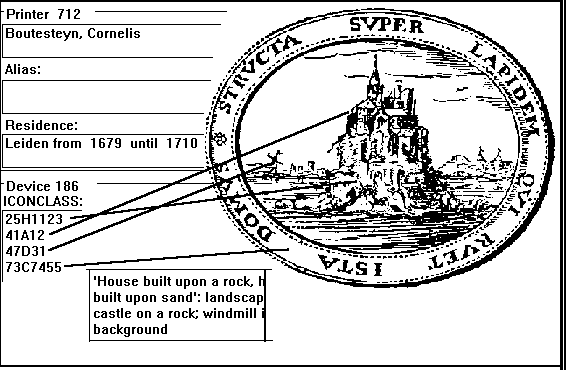
| Notation (Code) | Textual Correlate (Meaning) |
| 25H1123 | rock-formations |
| 41A12 | castle |
| 47D31 | windmill |
| 73C7455 | ‘house built upon a rock; house built upon sand’ « doctrine of Christ on love, etc. (Matthew 7:24-27; Luke 6:47-49) |